
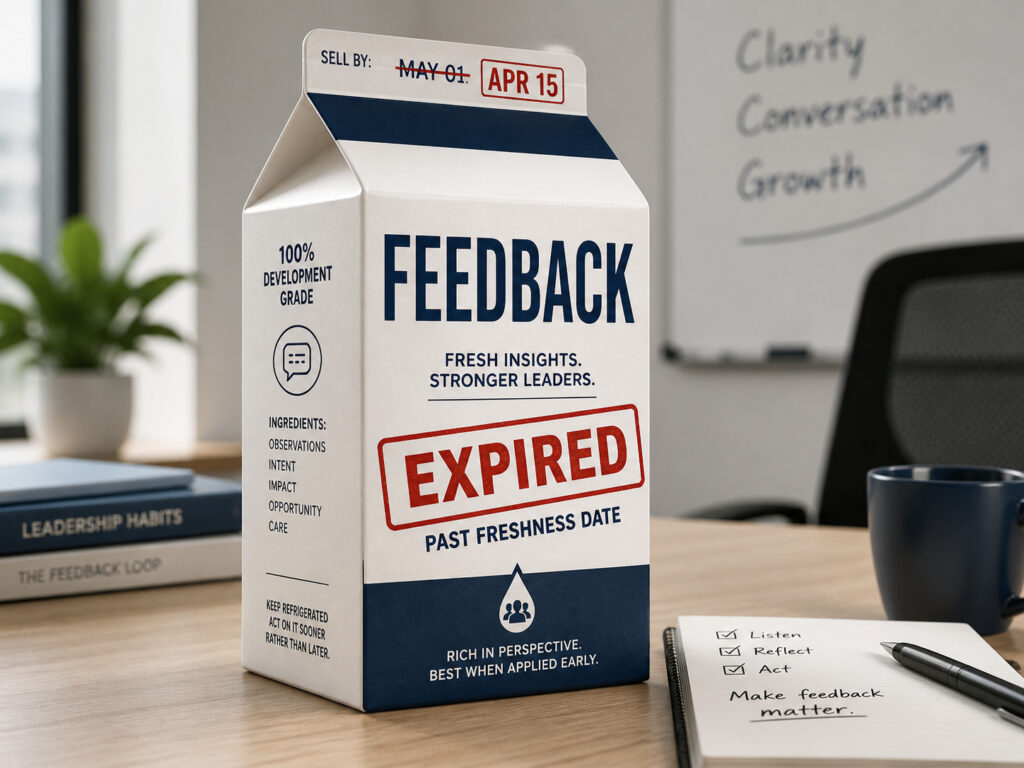
Leadership derailments are always uncomfortable to debrief. This one was painful.
James was a rising IT leader, sharp, credentialed, the kind of person who makes things happen. He’d come through my Executive MBA leadership course, and when he called to catch up, I could hear something was off. Twelve months earlier, a West Coast firm had hired him to modernize their IT infrastructure. The CEO wanted transformation, and James drove hard. What he didn’t see coming was the conversation that ended his tenure.
Peers had been raising concerns for months. But he disregarded their suggestions as ill-informed and their concerns as mere resistance. He’d been told, in various ways, to slow down, integrate, bring people along. He heard it. He just didn’t act on it in time.
That’s what I mean when I say feedback has a freshness date.
By the time the CEO called James in, the window for a smaller, smarter course correction had closed. What could have been a discussion about adjusting his approach became a conversation about ending his role.
Coachability, real coachability, isn’t just being open to feedback. That framing is too passive. It’s the discipline of seeking useful input early enough to use it, responding without defensiveness, reflecting on what you hear, and making visible changes on time. The leaders who do this well don’t wait for feedback to arrive at the end of the process. They build it into the work, even when driving change.
Seek it at the midpoint, not the finish line
One of the best feedback practices I’ve seen belongs to a coach I respect named JW Womack. About halfway through any coaching session or meeting, he stops and asks a simple question:
“We’re about halfway through. Are we getting what you need?”
It sounds small. It isn’t. That question, asked at the midpoint, accomplishes something that end-of-session feedback almost never does: it arrives while there’s still time to adjust. And the act of asking tells the other person that their experience of the work matters, not just the deliverable.
Compare that to the restaurant version of early feedback. The server drops your plates, takes three steps away, and turns back to ask, “How are the first bites?” The intent might be genuine, but it rarely feels that way. It feels like a script. Nobody expects a real answer. The kitchen isn’t actually waiting. That’s the difference between feedback as practice and feedback as theater, and most leaders, if they’re honest, do more of the latter than they realize.
The question worth asking isn’t “did I ask for feedback?” It’s this: did I ask at a point when the answer could still change something?
The window you don’t know you’re closing
Here’s something I’ve observed consistently in working with new leaders, and it doesn’t show up in leadership onboarding programs.
When someone steps into a new role, there’s a window, roughly the first six months, when the people around them are unusually generous with honest input. Peers will offer perspective. Direct reports will flag things they notice. Stakeholders will share concerns they’d normally keep to themselves. It’s not that everyone suddenly becomes candid. It’s that there’s an unspoken grace period. People give new leaders the benefit of the doubt, and with it, a quality of coaching that gradually disappears.
Around month six or seven, something shifts. The unofficial coaching dries up. The mental model people carry about the leader solidifies, and the attitude quietly becomes by now, they should know. Colleagues who were once offering course corrections start working around the leader instead of trying to help them.
I used to run six-month new leader surveys specifically to keep that early feedback window open longer. The survey gave people a structured reason to keep offering the kind of input they’d otherwise have stopped giving. It allowed the new leader to check in, affirming their ongoing interest in feedback and their commitment to act on it.
Leaders who don’t build feedback habits early in a role don’t just miss useful information. They miss a quality of candor that doesn’t come back easily.
When feedback stops being offered
There’s another expiration worth understanding, one that’s less about timing and more about what happens after the ask.
Researcher Adam Grant and his colleagues found something that should give every leader pause: seeking feedback alone doesn’t reliably build psychological safety in teams. What does build it, and sustain it, is sharing feedback by openly discussing what you’ve already been told, what you’re working on, what you’re trying to change. The implication is concrete: asking for feedback without closing the loop doesn’t just waste the input. It slowly poisons the well for the next ask.
My new leader survey process required leaders to debrief their results directly with their team and key stakeholders, then follow up by stating what they committed to change. The list was rarely long. A few timely course corrections, made early enough to matter, were usually all it took. Doing it visibly made the difference: people saw that the feedback had landed, and the door stayed open for more.
The signals James missed
Looking back at James’s situation, the feedback wasn’t absent. It was actually fairly consistent. What was absent was a practice, any structured moment where he stepped back and asked himself whether the signals he was receiving warranted a change in direction.
The leaders I’ve coached who navigate this best aren’t the ones who move slowly. They’re the ones who build deliberate pauses into the speed. A halfway check-in with a key stakeholder. A direct question to a trusted peer. A moment at the end of a tough week to ask themselves or a trusted advisor:
“What might I be missing or ignoring that I should act on?”
For leaders who can’t answer that question honestly on their own, that’s often the signal that they need a truth-teller in their corner, or a coach willing to ask it for them.
Why the truth gets quieter over time
The need for signal-catching goes beyond leaders who are new in a role. The higher you go, the more filtered your feedback becomes. People get careful. They soften the message. They wait for the right moment, then decide the moment never comes.
This isn’t always because the leader is defensive. Sometimes it’s simply positional. Seniority creates distance. Busyness signals inaccessibility. And people make quiet calculations about whether speaking up is worth the risk.
This is why every leader needs what I call truth-tellers. Not the chronic critics, but the people who care enough about the work and your success to give you the whole story. They might be a direct report, a peer, a trusted client, or a colleague who’s known you long enough to say what others won’t.
A useful test: when did someone last tell you something you didn’t want to hear? If you have to think hard, the people around you may have already stopped offering.
Truth-tellers don’t stay truth-tellers if the truth gets punished. Not through retaliation, since most leaders aren’t doing that. Through the subtler response: explaining, defending, changing the subject, or simply never circling back to what they raised. If the feedback goes nowhere visibly, the offer won’t come again.
Keep the feedback fresh
Feedback has a freshness date. That’s not a metaphor about speed. It’s a metaphor about conditions, about whether the people around you still believe that offering honest input is worth the risk.
James had people who were willing to take that risk. His peers flagged concerns throughout the year, in conversations, in hesitations, in the kind of sideways feedback that leaders either learn to read or learn to regret. He wasn’t without information. He was without a practice that would have helped him take that information seriously before it was too late. By the time the CEO called him in, his colleagues had long since stopped expecting things to change. The window had closed, and he hadn’t noticed it closing.
The coachable leader builds the habit of asking before urgency forces the question. Ask at the midpoint, when there’s still room to move. Ask early in a role, when people are still generous enough to tell you what they actually see. When you receive feedback, act on it visibly so the door stays open for the next honest conversation.
That’s the real discipline of coachability as a practice you build before the feedback you need most quietly expires.
A note for coaches and talent development leaders
The leaders most at risk from an expiring feedback window rarely know it. They’re moving fast, delivering results, and the silence around them feels like consent. Your job is to surface what they’re not noticing before the window closes and the conversation gets expensive.
While I like 360s and the new leader survey, the most useful intervention is a direct question:
“Who in your world is most likely to tell you something you’d rather not hear, and when did they last do it?”
If the leader names someone quickly and recently, they probably have a functioning truth-teller relationship. If they pause, hedge, or can only reach back six months or more, you have your opening. Follow it with one more: ‘What did you do with it, and did they see you do it?’ The first question finds the gap. The second tells you whether the feedback actually landed or just passed through.”